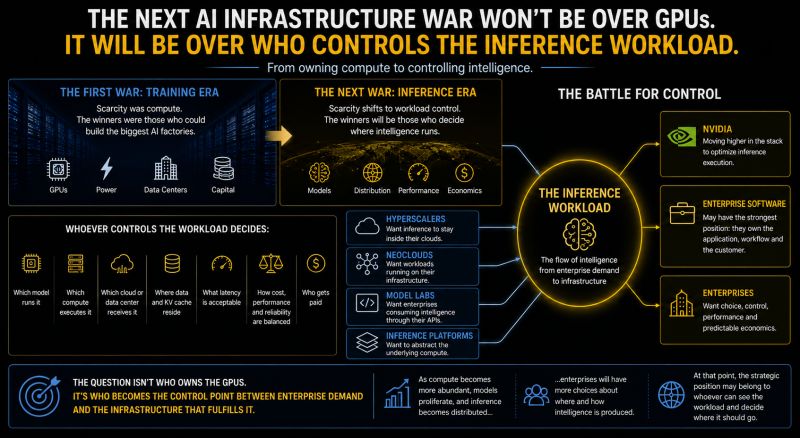
IT WILL BE OVER WHO CONTROLS THE INFERENCE WORKLOAD.
For the last several years, the strategic asset in AI has been obvious: compute capacity. Who had GPUs? Who could finance them? Who could power them?
That dynamic made NVIDIA, hyperscalers, and NeoClouds enormously powerful. But the shift from training to inference is changing the game.
As AI transitions to running billions of production workloads, the scarce strategic asset moves from hardware ownership to workload control. And with it, power is shifting from Big Tech to Enterprise customers and those who control access to them.
Why Inference Shifted the Control Point
Whoever controls the inference workload determines:
- Model & Hardware: Which model runs and which accelerator executes it
- Data & Routing: Where KV cache resides, which cloud receives the request, and what latency is acceptable
- Economics: How cost, performance, and reliability are balanced
Ultimately, whoever controls the routing controls who gets paid.
The Battle Lines Are Drawn
- Hyperscalers: Want inference locked inside their cloud ecosystems
- Model Labs: Want enterprises consuming intelligence strictly via their APIs
- Inference Platforms: Want to abstract away the underlying compute entirely
- NVIDIA: Moving up the stack with software like Dynamo to optimize execution
- Enterprise SaaS: Sitting on the strongest position by owning the application, workflow, and customer relationship
History Repeats Itself
Value routinely migrates from physical infrastructure to traffic control:
Cloud migrated from racking physical servers to orchestrating workloads Payments migrated to platforms controlling transaction flow. AI will follow a similar path.
The Bottom Line:
The first AI infrastructure race was about accumulating compute. The next is about controlling the flow of intelligence.
As compute becomes commoditized and infrastructure heterogeneous, the strategic high ground belongs to whoever sits between enterprise demand and intelligence fulfillment.