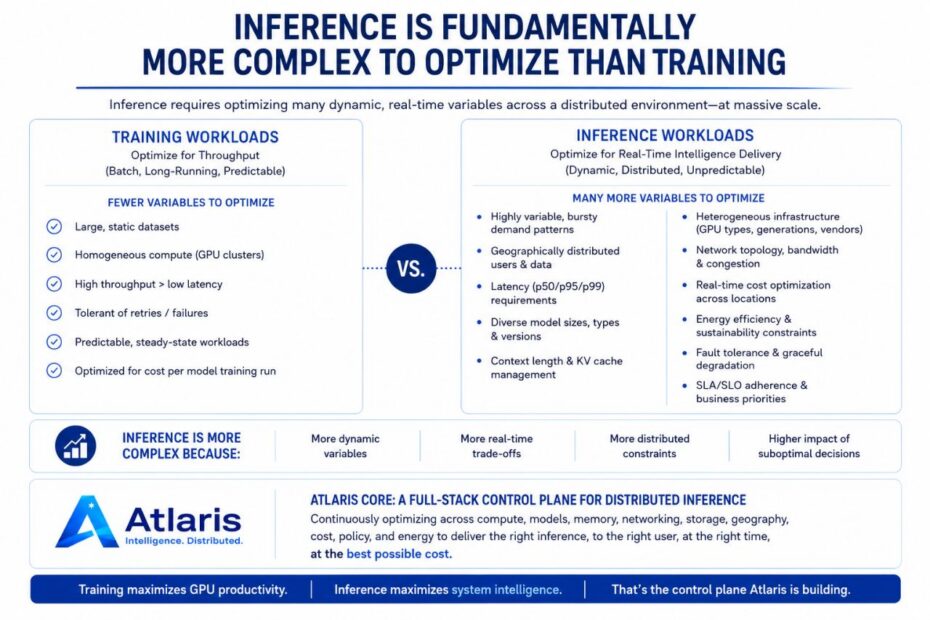
Inference is not just more compute-intensive than training—it is fundamentally more complex to optimize. GPU Schedulers and other point solutions only solve a single dimension of the problem.
Training is difficult, but the optimization problem is relatively bounded: assemble massive datasets, provision homogeneous GPU clusters, run long-duration batch jobs, and maximize throughput.
Inference fundamentally changes the equation. Instead of predictable batch workloads, every single request introduces a real-time matrix of shifting variables:
- Model parameter size and quantization strategy
- GPU/accelerator architecture, memory bandwidth, and immediate availability
- Context length and KV cache state (e.g., retrieving a 128k context vs. a 4k prompt)
- Geographic origin, network hop efficiency, and p99 latency targets
- Compute cost arbitrage across dynamic pricing zones
- Data sovereignty, compliance boundaries, and localized power constraints
Consider a simple enterprise query: A low-latency user request in Frankfurt requires a 70B parameter model with a pre-warmed KV cache in Dublin. Routing the query to Dublin satisfies context cache efficiency but adds 25ms of cross-border network latency and violates strict EU data residency rules. Meanwhile, a local Frankfurt node has available capacity, but only on an older accelerator architecture that increases time-to-first-token by 40%. Balancing these trade-offs requires evaluating tens of thousands of potential execution paths in sub-millisecond windows.
Existing point solutions—GPU schedulers, model routers, inference runtimes, and energy managers—only optimize isolated layers of the stack:
- The optimal GPU may sit in the wrong geographic region.
- The cheapest compute node may push p99 latency over a critical SLA threshold.
- The lowest-latency cluster may lack the required accelerator or KV cache state.
- The most energy-efficient routing decision may violate a geographic security policy.
Solving this requires moving beyond cluster scheduling toward a full-stack, real-time control plane for distributed inference—continuously orchestrating across compute, models, memory, networking, storage, policy, and energy.
This is what we are building at Atlaris.
Atlaris Core is built to solve this multi-variable optimization problem. The goal is not simply keeping GPUs busy at near-full utilization, but dynamically determining the precise infrastructure, model variant, location, network path, and execution timing for every request at the lowest possible cost.
The Bottom Line:
Training was about maximizing the productivity of static clusters. Inference is about maximizing the efficiency of a dynamic, intelligent system. The winning infrastructure of the inference economy will incorporate a control plane that coordinates it all across a distributed fabric.