Enterprise inference is about to create a radically different one.
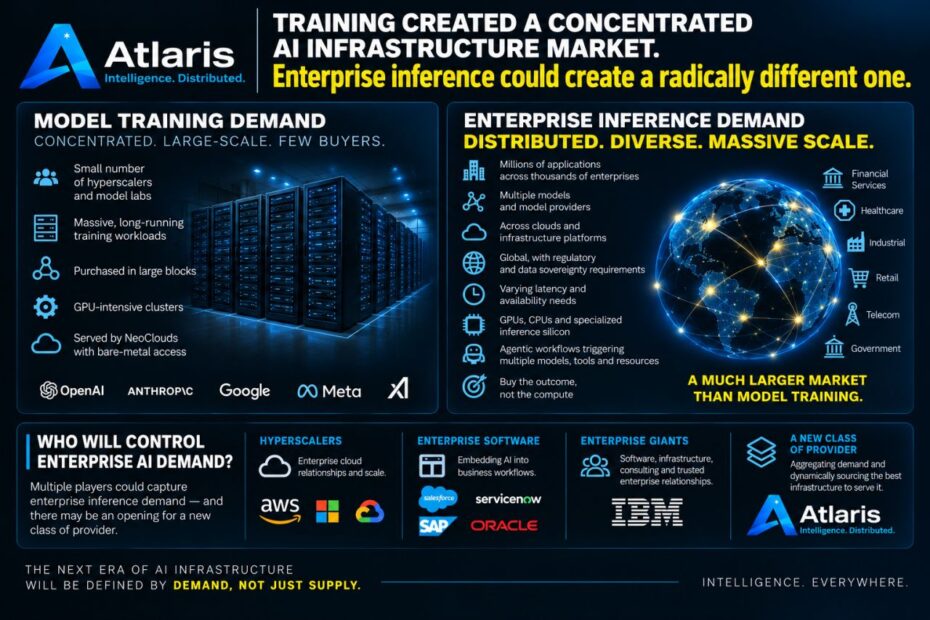
The AI infrastructure market today was shaped by the economics of training: a small group of hyperscalers and model labs consuming massive compute blocks.
Concentrated demand, giant workloads, and long-term capacity contracts skewed the economics.
Scarcity brought rise of the NeoClouds – and to large centralized mega-clusters optimized for brute force frontier model training.
Enterprise inference demand will look nothing like this.
Instead of a few giants consuming huge clusters, enterprise inference will be driven by millions of applications generating trillions of transactions.
Distributed workloads will be across thousands of enterprises, diverse models, multiple clouds, and varying regulatory regimes.
Execution will span GPUs, CPUs, and specialized inference silicon based on real-time latency and cost constraints.
Agentic AI will drive enormous complexity: A single business outcome will trigger complex multi-model, multi-tool workflows automatically.
Most enterprises don’t care about the underlying infrastructure. They want to buy the outcome, not the raw compute. This raises the defining question for the next era of AI:
Who Will Aggregate Enterprise Inference Demand?
- Hyperscalers hold an initial edge via existing cloud distribution.
- Enterprise Software Giants (Salesforce, ServiceNow, SAP, Oracle) are embedding AI directly into business workflows. Their customers won’t buy inference—they’ll buy AI-enabled outcomes, making the software vendor the primary demand aggregator.
- Hybrid giants like IBM sit at the intersection of enterprise software, hybrid cloud, and deep industry relationships inside highly regulated environments.
- A New Class of Inference Service Providers—layering above raw compute to aggregate demand and dynamically route workloads.
Rather than just selling raw capacity, this new service layer sits directly between the enterprise and the physical infrastructure. It takes incoming demand and continuously evaluates the full stack—matching the right model, compute, network path, and data privacy rules to execute every request optimally. The enterprise simply gets the final outcome without ever having to manage the mechanics underneath.
This is a core part of the thesis behind Atlaris. We believe enterprise inference will increasingly be bought as an intelligence service rather than raw infrastructure. Over time, every inference request becomes a real-time market transaction—balancing model choice, hardware location, and cost to deliver the best result.
The Bottom Line:
Training demand was concentrated. Enterprise inference will be massively distributed. As inference becomes the dominant share of the market, the strategic control point shifts from supplying compute to aggregating demand. The race to control enterprise AI demand is just getting started.