Training infrastructure is difficult to operate.
Inference infrastructure will be difficult to understand.
And agentic AI makes the problem dramatically harder.
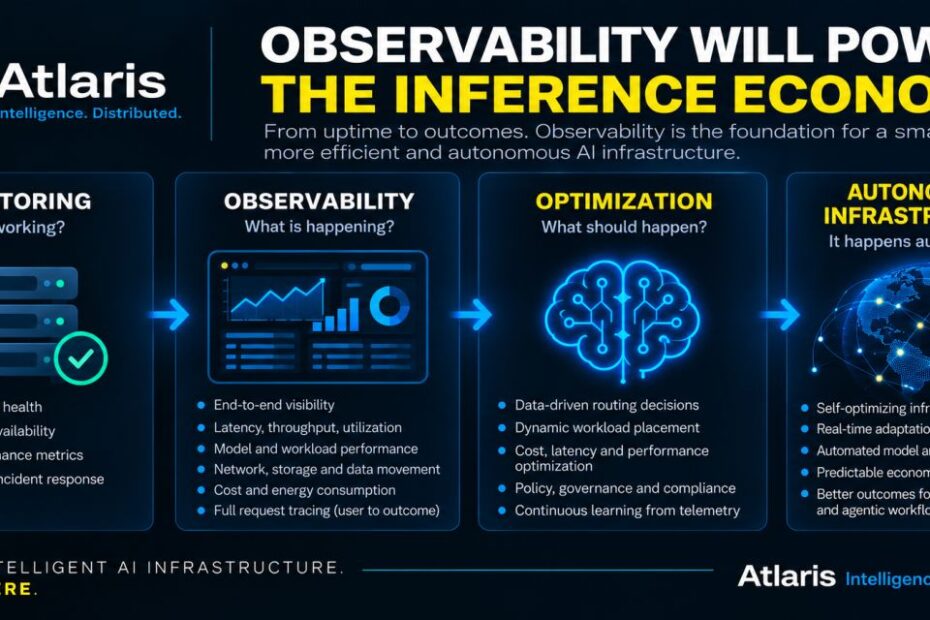
Traditional monitoring and observability asks familiar questions:
- Is the GPU healthy?
- Is the network congested?
- Is memory saturated?
- Is the application responding?
Inference introduces a much larger optimization space.
Now operators need visibility into:
- GPU / accelerator utilization
- queue depth and batching efficiency
- TTFT and inter-token latency
- KV-cache hit rates and placement
- model routing and model performance
- network latency and data movement
- memory and storage utilization
- power consumption
- geographic location
- cost per token — and ultimately cost per outcome
Agentic applications add another layer.
A single user request may trigger dozens—or eventually hundreds—of model calls, tool calls, retrieval operations and reasoning steps across multiple models and infrastructure environments.
The relevant question is no longer simply:
“Did the Application respond?”
It becomes:
“What actually happened across the entire chain of intelligence that produced the outcome?”
That requires tracing the path from:
USER INTENT
→ AGENT
→ MODEL
→ COMPUTE
→ NETWORK
→ DATA
→ TOOLS
→ OTHER AGENTS
→ OUTCOME
This has a profound implication for AI infrastructure.
Observability stops being primarily an operations function. It becomes an optimization function.
The infrastructure layer that can see enough of the system can begin to answer much more valuable questions:
- Where should this workload execute?
- Which model should handle it?
- Which accelerator is most economical?
- Should KV state move—or should compute move toward the state?
- And could the same outcome have been produced faster, cheaper or more reliably somewhere else?
This is particularly important in distributed inference architectures, where compute, models, data and users may exist in completely different locations.
At Atlaris, we think of this telemetry as foundational to the control plane. Every inference workload creates another data point about how models, silicon, networks, storage and geography interact.
Over time, that creates something potentially much more valuable than a monitoring dashboard: a continuously learning map of the economics and performance of AI infrastructure. And that map can make the next routing decision better and faster.
The Bottom Line:
In the agentic era, you cannot optimize what you cannot observe. And as AI infrastructure becomes increasingly distributed, heterogeneous and dynamic, observability may become one of the most important control surfaces in the inference economy.
#AI #AIInfrastructure #Inference #AgenticAI #Observability #DistributedAI