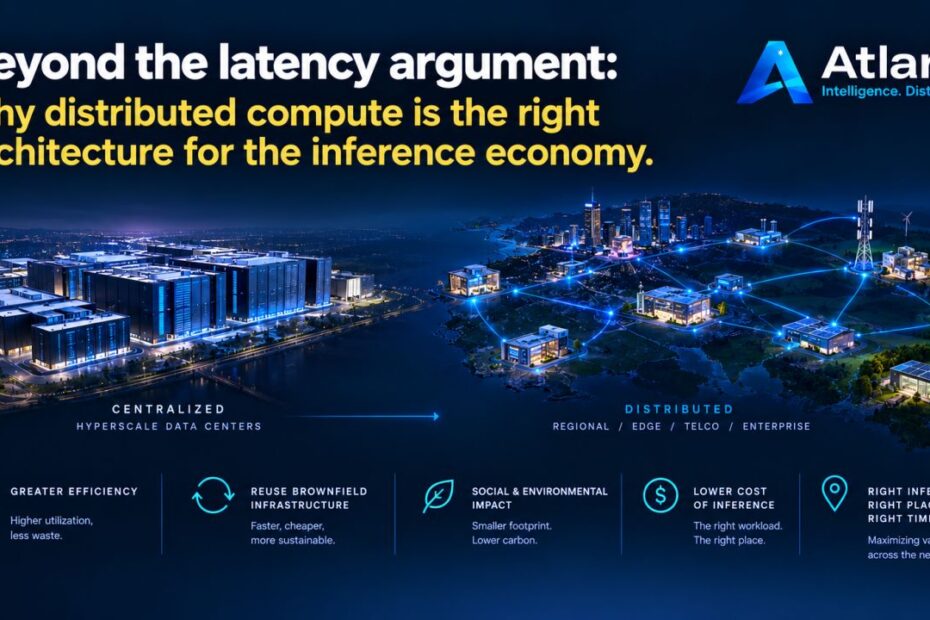
The argument for distributed AI data centers is often framed around latency. But that is only the beginning.
In the early days of computing, organizations centralized workloads around large mainframes. Over time, that model gave way to networks of powerful PCs and servers. The result wasn’t the end of supercomputers—it was a more economically efficient system where they were reserved only for workloads that actually required them.
AI inference is approaching a similar transition.
While the case for distributed inference usually starts with latency, the real shift is economic. Distributed compute offers a fundamentally better model for the scale of the inference economy.
- Infrastructure Reuse
We don’t need to build every AI workload inside massive greenfield campuses. Millions of square feet in existing data centers, telecom facilities, and enterprise sites can be repurposed. Reusing existing grid connections can cut deployment timelines by years compared to waiting years for new hyperscale power interconnections. - Lower Cost Per Inference
Inference economics differ sharply from training. Workloads are continuous and location-sensitive. Shifting inference away from peak-demand flagship chips to optimized accelerators can reduce operating costs by 30% to 60% without sacrificing user experience. - Smarter Routing
Processing requests across a distributed network can improve efficiency by routing requests to the right compute at the right time at the right cost. - Environmental Efficiency
AI is a massive consumer of land, power and water. Repurposing existing buildings and power infrastructure can slash these impacts, mitigating community pushback to new data centers. - Dynamic Power Optimization
A distributed architecture turns power into a real-time variable. An intelligent platform can route non-time-sensitive workloads dynamically based on electricity prices, grid constraints, and time of day. - Not Every Workload Needs a Supercomputer
We stopped using mainframes for basic tasks. AI inference will follow the same curve. Specialized, heavy reasoning models will stay in centralized clusters; high-volume edge and task-specific models run far better on distributed infrastructure.
The future isn’t centralized vs. distributed. It’s centralized when specialization justifies it—and distributed when economics demand it:
- Right hardware
- Right location
- Right time
- Right price
The next generation of AI infrastructure won’t just add more compute—it will create an intelligent network that dynamically optimizes where and how that compute runs.
The Bottom Line:
Centralized clusters built the foundation for AI training, but distributed networks will win the economics of AI inference. Better compute economics – not just bigger data centers – will define the next era of AI scale.