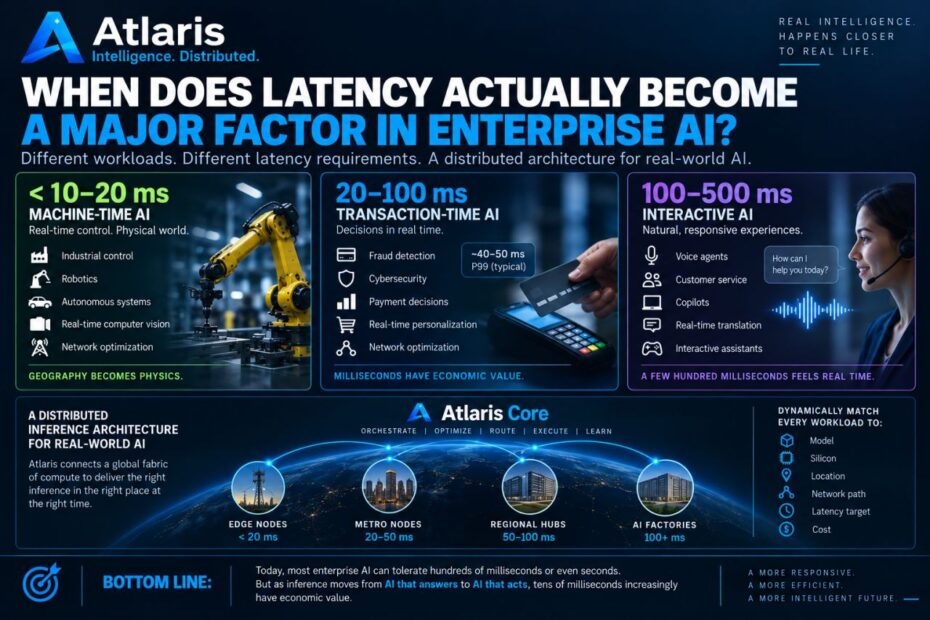
We often hear that AI inference needs to move closer to the user.
But how many enterprise AI workloads actually need low latency today?
Probably fewer than the edge-AI narrative suggests. For summarization, research, and asynchronous agents, an extra 50–100 ms of network latency doesn’t matter when model execution takes seconds.
But an emerging class of real-time workloads looks very imminent:
(1) < 10–20 ms: Machine-Time AI
- Industrial control & robotics
- Autonomous systems
- Real-time computer vision
When inference enters a closed control loop, geography becomes s more critical.
(2) 20–100 ms: Transaction-Time AI
- Fraud detection & cybersecurity
- Real-time payments
- In-stream personalization
Here, network delay can eat up the whole budget.
(3) 100–500 ms: Interactive AI
- Voice agents & conversational AI
- Live customer service copilots
- Real-time translation
NVIDIA targets time-to-first-token (TTFT) in a few hundred milliseconds for natural conversational flow. A recent Comcast/NVIDIA test maintained <500 ms end-to-end voice latency across a 4-site distributed architecture during traffic bursts.
The Latency Paradox
End-to-End Latency = Network RTT + Queueing + Prefill + Model Execution + Decode + RAG Retrieval + App Overhead.
This creates a paradox: The faster inference gets, the more network latency matters. BLF execution takes 2,000 ms, shaving 60 ms off network RTT is rounding error. But If an execution drops to 80 ms, dropping network RTT from 80 ms to 20 ms slashes total time from 160 ms to 100 ms—a 37.5% reduction.
Where This Is Headed
As models shrink, silicon accelerates, and voice becomes native, AI moves from answering questions to taking real-time actions.
We are moving to tiered architectures;
- Hyperscale AI factories for massive asynchronous jobs
- Regional/metro nodes for interactive voice and transaction paths
- On-device/on-prem for ultra-low latency machine control
At Atlaris, we are building for this distributed reality.
Atlaris’ deep orchestration software dynamically routes:
Workload → Model → Silicon → Location → Network Path → Latency → Cost
The goal isn’t just to minimize latency—it’s to optimize the trade-off between latency, performance, and cost across a heterogeneous compute fabric.
The Bottom Line:
Today, most enterprise AI tolerates seconds of delay. Tomorrow, as AI transitions from answering questions to taking action, tens of milliseconds will carry real economic value. The winners will be the architectures that deliver the right inference in the right place at the right time—at the right price.